


What a fall day offshore teaches us about where the money goes.
A Weekend Offshore
This past weekend I went offshore with my son. Being out on the water is where I do my best thinking, and this time of year it always teaches the same lesson: the fish don’t disappear in the fall. They move. Find where they went, and the bounty is still there.
That’s the best explanation I know for what’s happening in the markets right now.
A Predictable Change of Season
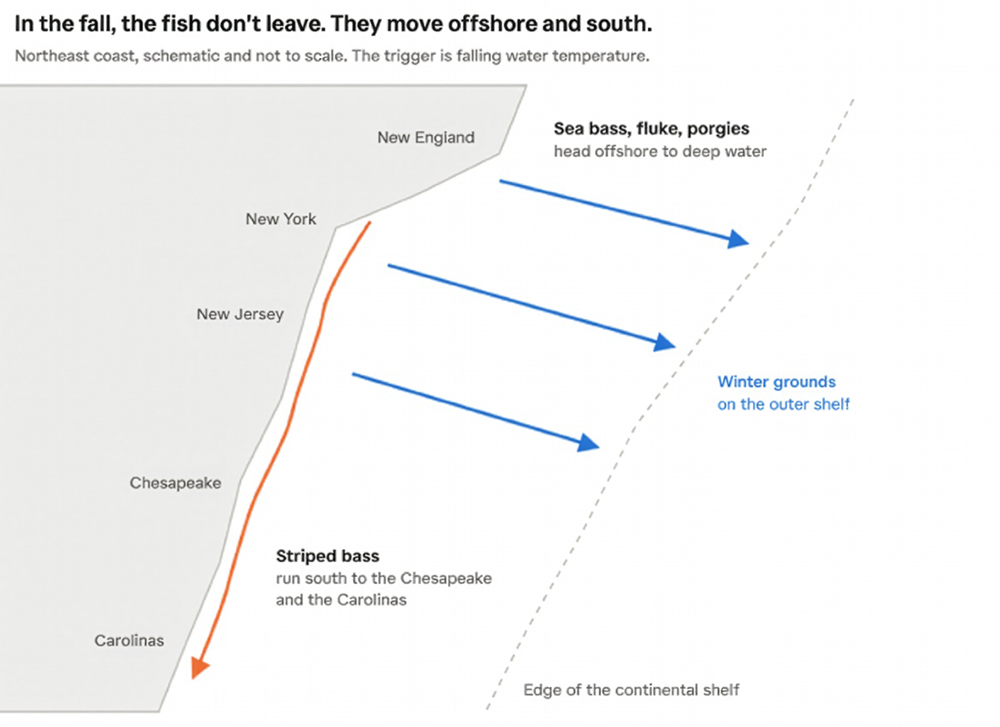
Every fall, as the water cools, black sea bass, fluke and porgies leave the inshore spots for deeper, warmer water offshore. Striped bass head south down the coast. Experienced captains know roughly when it will happen and where the fish will go. And the fish never leave the ocean. They just change neighborhoods.
 https://jjburns.com/wp-admin/post.php?post=999674033235658&action=edit#edit_timestamp
Fall migration routes – schematic, based on NOAA tagging research and regional fishing reports.
The Money Migration
Money behaves the same way. It doesn’t leave the market so much as it moves to where conditions are better. For fish, the signal is water temperature. For investors, it’s valuation: when one area gets expensive relative to what it earns, money moves toward areas offering better value.
That’s what we’ve seen this fall. After years of a handful of AI and mega-cap tech names leading the way, investors are asking those companies to show a return on their spending. Morningstar called it an “Anything but AI” rotation and estimated the broad U.S. market was trading roughly 10% below fair value at the end of October.
Then came the storm. On November 20, the S&P 500 fell 3.7% and the Nasdaq 5.3% as investors pulled back from AI stocks. The S&P 500 and the Dow are now in correction, more than 10% below their highs, and the Nasdaq-100 briefly crossed into bear-market territory, 20% off its peak, before closing just shy of it. Year to date, the S&P 500 is up just 0.9%, and the Nasdaq is down 2.7%. Yet 9 of 11 sectors are still positive for the year, led by energy, consumer staples and health care.
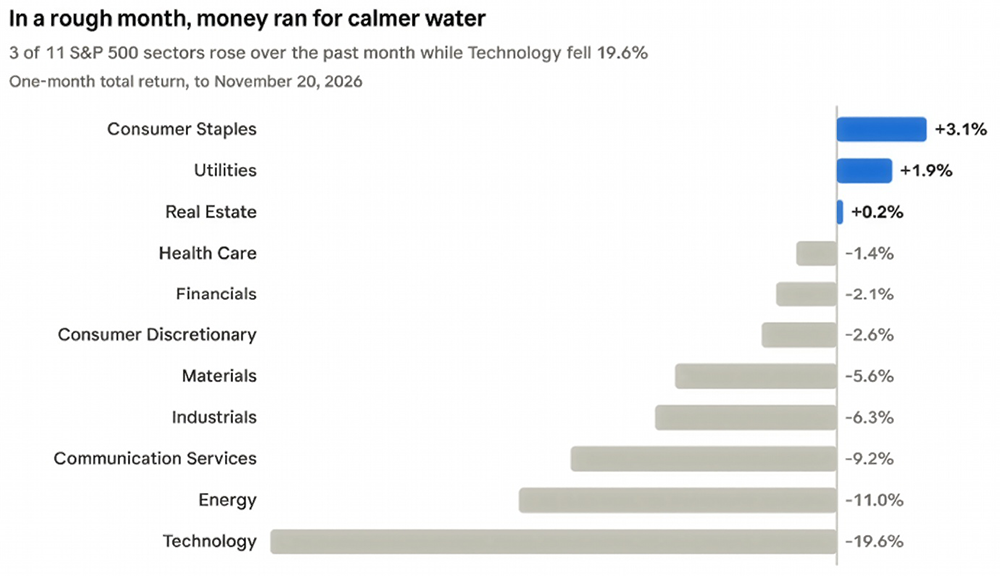
Chartrow, Select Sector SPDR ETF total returns – one month to Nov 20, 2026.
When a Squall Blows Through
The season sets the direction. The weather sets the pace. A hard storm can push fish off a spot overnight, but the migration was coming anyway.
We’ve had a week of squalls. On November 12, a Microsoft 365 outage locked people out of Outlook and Teams worldwide. The same day, Jensen Huang resigned as Nvidia’s CEO. The next afternoon, an FAA telecommunications failure grounded flights nationwide, and roughly 12,000 flights were canceled.
Nvidia hasn’t recovered. Despite beating earnings, it fell about 14% on November 20 amid a reported SEC probe of its disclosures.
Anthropic, the maker of Claude, went public on November 19 in the largest IPO in history. Shares closed their first day up 17% at $97.17, then fell 8.5% on Friday as the selloff spread.
That’s why we never let one stock or one theme steer the whole boat. Storms like this test every captain, but they’re weather, not climate.
The Captain’s Lesson
The fish didn’t disappear. They went deeper. A good captain doesn’t sell the boat. He moves it.
When the bite slows, the experienced captain stays open and patient, trusts a proven process, and repositions. That’s how we approach your portfolio:
- Stay diversified. A diversified portfolio already has lines in the water across many sectors.
- Rebalance with discipline. When one area runs hot, we trim it and add where the value has moved, by process, not by headline.
- Stay invested. Going to cash after a storm is like leaving the ocean because the bite slowed.
Every Boat Is Rigged Differently
No two trips are planned the same way. Fuel range, the boat, who’s aboard and when everyone needs to be home all shape the plan.
Portfolios work the same way. In a taxable account, every trim can create a capital gains bill, while the same move inside an IRA may cost nothing in current taxes. A family drawing income needs a different plan than one still building wealth. Required minimum distributions, charitable giving, a business sale and gifts to children all change how far and how fast we can move.
That’s why we start with how you live your life, not with the market. We decide which accounts to rebalance in, where to harvest losses to offset gains, and where your distributions should come from, so more of the catch makes it back to the dock.
For families of significant wealth, there’s one more storm that must always be tracked: the estate. Federal and state estate taxes can claim a meaningful share of what a family has built, and the rules keep changing. We plan for the transition of a family business and the needs of every generation, so your wealth passes on the way you intend. A good captain never stops watching the weather, and we never stop watching the estate plan.
Pass It Along
We’ve been getting a lot of calls about the Microsoft outage, the shake-up at Nvidia and the grounded flights. If this note helped, please share it with your friends and family, who may have the same questions. And if you’d like to talk about how your own portfolio is positioned for the season ahead, give us a call.
– Your Wealth Management Team at JJ Burns & Company
market volatility markets stock market
Disclosure: J.J. Burns & Company, LLC is a registered investment adviser with the U.S. Securities & Exchange Commission and maintains notice filings with the States of New York, Florida Pennsylvania, New Jersey, Connecticut, Georgia, Illinois, North Carolina, and California. J.J. Burns & Company, LLC only transacts business in states where it is properly registered, or excluded or exempted from registration. Follow-up and individualized responses to persons that involves either the effecting or attempting to effect transactions in securities, or the rendering of personalized investment advice for compensation, as the case may be, will not be made absent compliance with state investment adviser and investment adviser representative registration requirements, or an applicable exemption or exclusion.
All investing involves risk, including the potential for loss of principal. There is no guarantee that any investment plan or strategy will be successful.
The foregoing content reflects the opinions of J.J. Burns & Company, LLC and is subject to change at any time without notice. Content provided herein is for informational purposes only and should not be used or construed as investment advice or a recommendation regarding the purchase or sale of any security. There is no guarantee that the statements, opinions or forecasts provided herein will prove to be correct.
Past performance may not be indicative of future results. Indices are not available for direct investment. Any investor who attempts to mimic the performance of an index would incur fees and expenses which would reduce returns.
Securities investing involves risk, including the potential for loss of principal. There is no assurance that any investment plan or strategy will be successful.