


How France’s civil unrest ripples through financial markets, and what it’s teaching investors right now
A Note From Our Investment Team
At our most recent investment meeting, our portfolio managers spent a good part of the session on a question that rarely makes the financial pages directly: What happens to markets when a country’s streets turn restless? You may be wondering whether protests an ocean away have anything to do with your money. Usually they don’t. But every so often, social unrest becomes the spark that forces markets to reprice risk, and France is giving us a live case study. Our team has watched this pattern play out before, in 1987, in 2008, and in the 2011–12 eurozone debt crisis, the last time French bonds looked like this.
How Unrest Reaches a Portfolio
Civil unrest rarely moves markets on its own. It matters when it collides with a fragile balance sheet. The chain usually runs like this:
- Unrest paralyzes policy. When governments face angry streets, spending cuts and tax increases become politically impossible, even when the math demands them.
- Paralysis erodes credibility. Bond investors stop believing deficits will close and demand more yield to lend. That extra yield is the “risk premium.”
- Higher yields feed the problem. More expensive borrowing widens the deficit, which raises yields again, a feedback loop markets watch closely.
- Stress spreads. Banks holding the government’s bonds, the country’s stocks, its currency, and eventually its neighbors can all feel the repricing.
France today has every link in that chain.
The Headline Numbers
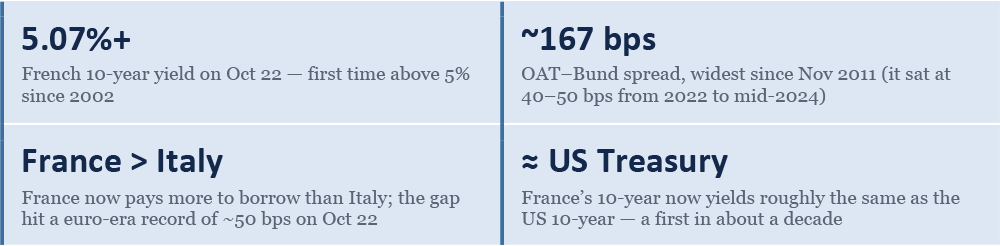
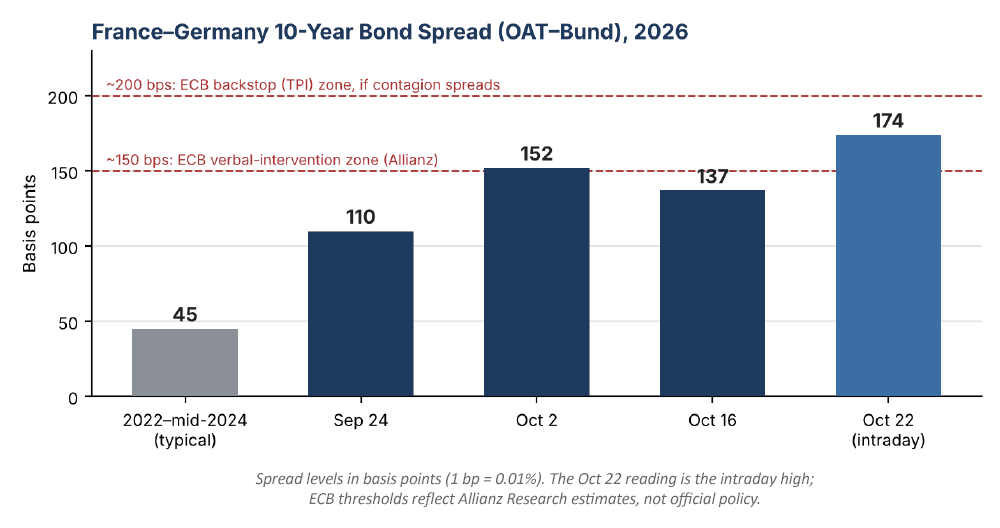
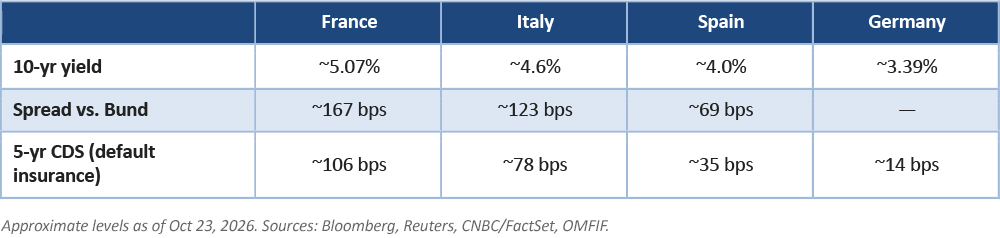
The OAT–Bund spread is the extra yield investors demand to lend to France instead of Germany. It is Europe’s most-watched gauge of fiscal stress, and it has roughly tripled in two years. Even the market for default insurance is saying the same thing: French five-year credit default swaps reached about 106 bps on Oct 23, versus roughly 78 for Italy, 35 for Spain, and 14 for Germany.
Why Markets Are Losing Patience
- A structural spending problem. French public spending runs about 57% of GDP, the highest in the euro area, with pensions alone near 14%. The state carries almost the entire retirement burden, and neither pensions nor healthcare costs are shrinking.
- Debt that keeps compounding. Public debt hit a record 119% of GDP in mid-2026 and the government itself projects 121.7% next year. Interest costs are budgeted to jump from about €79 billion in 2026 to €91 billion in 2027, and could reach 3.7% of GDP by 2030.
- No printing press. As a euro member, France can’t create its own currency to ease the burden. Its only levers are spending cuts, tax increases or growth — all hard to pull at once.
- Politics in gridlock. A minority government is trying to pass a €54 billion savings package, with a first budget vote set for November 3 and a national strike planned for November 5, against a backdrop of violent student protests. The 2027 presidential first round is April 18, with the National Rally candidate leading polls at roughly 35%.
- An energy squeeze. Brent crude cleared $111 this week amid Gulf shipping attacks, worsening France’s deficit math while fueling the cost-of-living anger that makes reform harder.
- A backstop that isn’t guaranteed. The ECB’s crisis tool (the TPI) is designed for “unwarranted” market moves, and France’s ongoing breach of EU deficit rules may complicate its eligibility. The ECB has signaled it won’t rush to the rescue.
Why We Found This Interesting
What caught our team’s attention isn’t France itself. It’s how clearly France shows the chain at work. A wealthy, established nation, a core member of the euro, is now paying more to borrow than Italy, not because its economy collapsed, but because protests and political gridlock have made investors doubt its ability to fix its finances. It is a real-time reminder that markets price confidence as much as they price numbers, and that social stability is part of what investors are paying for.
What It Means for Stocks, at Home and Abroad
When investors lose confidence in a country, money doesn’t disappear. It moves. Capital tends to leave the troubled market and look for safety and quality elsewhere:
- In the troubled country, stocks, especially banks and domestically focused companies, tend to come under pressure. France’s CAC 40 led European markets lower on October 22 as the 10-year yield broke above 5%.
- In its neighbors, the effect is mixed. Some markets feel the spillover, while stronger economies like Germany can attract money as a safe harbor.
- In the United States, our markets have historically been a primary destination when global investors go looking for depth, liquidity and stability.
The result is often that high-quality international companies get marked down along with the headlines, even when their own businesses are sound. Prices fall for reasons that have more to do with fear than with fundamentals.
Where the Opportunity Lies
That is exactly where discipline pays. A globally diversified portfolio has target weights for a reason. When one region sells off on fear, it drifts below its target, and rebalancing means systematically trimming what has held up and adding to what has become cheaper. It is the practical form of buying when others are selling, done by policy rather than by emotion.
We don’t need to predict how France’s politics resolve to benefit from that discipline. We only need to stay diversified, keep watching, and act thoughtfully when prices move away from value.
Why America Is Well Positioned
Through all of this, the US holds structural advantages no other country can fully match:
- The world’s reserve currency. Global trade, central bank reserves and much of the world’s debt are priced in dollars, which sustains demand for US assets.
- Control of our own money. Unlike France, which shares the euro, the US has its own central bank and borrows in a currency it issues.
- The deepest markets in the world. When global investors want safety and liquidity, US Treasuries and US companies remain the first place they look.
That doesn’t make America immune to its own fiscal questions, and we keep a close eye on them. But it does mean that when trouble strikes elsewhere, the US is far more often the harbor than the storm.
Our Pulse on a Connected World
We live and invest in a connected world. Events in Paris, Rome or Beijing can reach a portfolio in Melville within hours. Our investment team follows these developments constantly, not to react to every headline, but so that when markets overreact, we recognize it and can act with purpose. That is why we stay globally diversified: It protects you when one region stumbles, and it positions you to benefit when fear creates value.
Let’s Talk
Every family’s exposure and every family’s concerns are different. If any of this raised a question — about your international holdings, how we rebalance, your income plan, or simply what keeps you up at night — we’d welcome the conversation. What part of this matters most to you?
– Your Wealth Management Team at JJ Burns & Company
Sources: Bloomberg; Reuters; FXStreet (Oct 22, 2026); CNBC (Oct 2, 11, 13, 22); Fortune (Oct 2); Euronews (Oct 6, 19); OMFIF (Oct 20); EFG International; Allianz Research (Oct 9); MSCI; INSEE; French Ministry of Finance 2027 budget documents; Federal Reserve H.15; US Treasury / CBO. Data as of October 23, 2026.
Disclosure: J.J. Burns & Company, LLC is a registered investment adviser with the U.S. Securities & Exchange Commission and maintains notice filings with the States of New York, Florida Pennsylvania, New Jersey, Connecticut, Georgia, Illinois, North Carolina, and California. J.J. Burns & Company, LLC only transacts business in states where it is properly registered, or excluded or exempted from registration. Follow-up and individualized responses to persons that involves either the effecting or attempting to effect transactions in securities, or the rendering of personalized investment advice for compensation, as the case may be, will not be made absent compliance with state investment adviser and investment adviser representative registration requirements, or an applicable exemption or exclusion.
All investing involves risk, including the potential for loss of principal. There is no guarantee that any investment plan or strategy will be successful.
The foregoing content reflects the opinions of J.J. Burns & Company, LLC and is subject to change at any time without notice. Content provided herein is for informational purposes only and should not be used or construed as investment advice or a recommendation regarding the purchase or sale of any security. There is no guarantee that the statements, opinions or forecasts provided herein will prove to be correct.
Past performance may not be indicative of future results. Indices are not available for direct investment. Any investor who attempts to mimic the performance of an index would incur fees and expenses which would reduce returns.
Securities investing involves risk, including the potential for loss of principal. There is no assurance that any investment plan or strategy will be successful.